Sunday, July 12, 2020

Quick Home Maintenance Checklist

Thanks to Ashleigh Clark, Senior Loan Officer at Highlands Mortgage for sharing the following checklist.

Whether you're a new homeowner or a seasoned, home-owning veteran, we pulled together a quick home maintenance checklist that will help keep your biggest investment organized and looking great all year long. 

Weekly
Sweep floors and vacuum carpets
Clean bathrooms
Check all drains to make sure they aren't clogged
Make sure all interior and exterior light bulbs are working properly and replace as needed
Mow and edge lawn to maintain good curb appeal (if in season)
Remove weeds from flower beds (as needed)


Monthly
Replace air conditioning filter
Clean garbage disposal with baking soda, vinegar, and lemon
Dust (even the hard to reach places)
Clean the range hood and oven
Visually inspect the outside of the home and look for any damaged siding, loose shingles, etc.

Annually

Clean gutters
Replace batteries in all smoke and carbon monoxide detectors
Have a HVAC professional inspect your A/C and heating system
Check your roof, shingles, flashing, and vents for damage
Clean and organize your garage (if you have one)
Check under sinks to make sure there are no signs of leaks
Make on upgrade that can increase your home's value (e.g. new light fixtures, updated counter tops, etc.)


Ashleigh ClarkSenior Loan Officer | NMLS No. 92328
Office: (704) 307-9908 | Mobile: (704) 307-9908
Ashleighclark@highlandsmortgage.com
15235 John Delaney Drive | Charlotte, NC 28277
www.highlandsmortgage.com

Friday, July 10, 2020

Sometimes Stats Are Confusing

We live in a community that is served by a number of real estate brokerages and residents are used to getting updates in their mail tubes from several of them.  As a resident agent, I get those as well and am frequently asked about things that appear on them.  The first thing I tell people is that the sales information provided was current the day the flyer was printed, but it is very likely that it was already outdated the day it arrived in your tube.  That is why I encourage everyone to visit my website regularly for the most current stats and, if you want updates delivered to you, I'm happy to set up a personalized auto-email to keep you informed.  Whether you want info about the community in general or something more specific (like a particular model or, perhaps, basement or loft homes), parameters can be set to give you that information.

Today, a neighbor asked me if I could "offer some insight on what caused our Summit Collection to decrease in value according to the July 2020 report" that arrived today.  She was referring to a graph for Summit homes that showed the following: 
  • 2018 - $360,224
  • 2019 - $364,849
  • 2020 (thru June) - $360,363
This was my response...
2019 included the sale of 12 basement homes (and 7 loft homes) which sell for a higher price and, therefore, affected the average sale price.  In 2018 there were 7 basement homes (7 loft homes) and to date this year there have only been 6 basement  (5 loft homes) home sales.  Also, remember that size (models) of homes and lots affect price, so the average price isn't really telling you that values have gone up or down.  Let me know if you want me to send you the lists of closed homes for 2018, 2019, and 2020. 

2018
Single Story - 40
Basement - 7
Loft - 7

2019
Single Story - 38
Basement - 12
Loft - 7

2020 (thru June)
Single Story - 19
Basement - 6
Loft - 5

As of today there are only 25 active single family residences (SFR) and 4 Carriage Homes/Villas on the market.  When the document was printed, there were 34 homes for sale (though they didn't say if that included both SFR and CH/V or just SFR).  Check my website for the most current stats.
Within an hour of my response, the number of active SFRs dropped to 24.  See my posting below for an update on SCCL Sales.

One last note... when agents who aren't familiar with our community put listings on MLS, they don't always include the model name in the listing.  When a search is done for a particular model, those that do not have a model listed will not come up and may not be calculated on a graph such as the one that was referenced above.
----
Remember that each collection of homes has a variety of models.  The Summit collection, for example, includes 5 models (Copper Ridge, Surrey Crest, Tifton Walk, Vernon Hill, and Willow Bend).  Some of those homes have basements, some have lofts, some have wooded views, some have golf course or water views, and all have different looks (all vinyl siding, brick, and stone with different roof designs)... all of these things make a difference.  When looking for comps for a home, make sure you're comparing "apples to apples." Please contact me if you'd like to see what the comps for your home look like.  

Thursday, July 9, 2020

SCCL Sales Update 7/9/2020

June was an active month for home sales here in SCCL and inventory is now extremely low. If you have been considering selling your home, now might be a great time to put it on the market.
 
Be sure to check UP-TO-DATE STATS FOR SCCL tab 
above for most current stats.


 Home Inventory Determines What Kind of Market We Are In
Months of supply is the measure of how many months it would take for the current inventory of homes on the market to sell, given the current pace of home sales. For example, if there are 50 homes on the market and 10 homes selling each month, there is a 5 month supply of homes for sale.
  • Less than 6 months of inventory = Seller's Market with upward pressure on prices
  • More than 6 months of inventory = Buyer's Market with downward pressure on prices.
The charts below are based on what had been reported at the end of June, however, sometimes closing information isn't posted for several days and the chart may be off slightly.  Be sure to check the interactive versions of these charts using the STATS tab above.


Single Family Homes = 2.5 month supply at the end of June

Carriage Homes & Villas = 3.5 month supply at end of June

Saturday, July 4, 2020

HAPPY 4TH OF JULY


What It Means to Be an American

Author Unknown

 To believe in the promise
of a better tomorrow,
and stand united in our efforts
to give a peaceful nation
to our children...

To honor each other's differences
and cherish the richness of our history,
even as it continues to unfold
from sea to shining sea...

To love deeply
our friends and family, day by day,
and never take for granted
the privilege of calling ourselves American.


Wishing you all a safe and healthy 4th of July!


Thursday, July 2, 2020

Is the Health Crisis Driving Buyers Out of Urban Areas?

Article Courtesy of Keeping Current Matters/The KCM Blog

Is the Health Crisis Driving Buyers Out of Urban Areas?The pandemic has caused consumers to re-examine the components that make up the “perfect home.” Many families are no longer comfortable with the locations and layouts of their existing homes. The allure of city life (more congested) seems to be giving way to either suburban or rural life (less congested). The fascination with an open floor plan seems to be fading as people are finding a need for more privacy while working from home.

Recently, news.com released a report that revealed how buyers’ views of listings are leaning heavily to more suburban and rural properties. Here are the year-over-year percentage increases in views per property type:

  • Urban – 7%
  • Suburban – 13%
  • Rural – 16%
In the report, Javier Vivas, Director of Economic Research for realtor.com, gives these numbers some context:
“This migration to the suburbs is not a new trend, but it has become more pronounced. After several months of shelter-in-place orders, the desire to have more space and the potential for more people to work remotely are likely two of the factors contributing to the popularity of the burbs.”
Realtor Magazine also just reported that the desire to move is strongest in our city markets:

“Nearly 30% of respondents living in a high-density urban area say that the pandemic is prompting them to want to move by the end of the year…This is more than double the rate of those living in rural parts of the country, where residents are much more likely to stay put rather than to relocate.”

New Construction Also Seeing a Surge in Views

Since the pandemic has altered how consumers think about floor plans, builders are anticipating how future homes will change. In a recent press release by Zillow, it was explained that:

  • Builders believe as people spend more time at home during the pandemic, buyers are realizing which features of their homes are working and not working.
  • Homebuilders predict open-concept floor plans will be a thing of the past, as people now value more walls, doors, and overall privacy.
  • New construction, which offers the chance to personalize home features, saw its listing page views grow by 73% over last May.

The Virus is Even Impacting the Luxury Second-Home Market

It appears that COVID-19 is impacting the luxury market too. In an article released last week titled, Luxury Buyers Return to Market in Force, Danielle Hale, Chief Economist for realtor.com reported:

“Stay at home orders and social distancing have put a new value on the extra space. We’re seeing this in the luxury market as well, which could mean there is renewed interest from high-end buyers to find a second-home that is within driving distance from their primary residence.
Much like the suburbs are gaining favor with home shoppers, second home markets are seeing increased interest from luxury buyers…Views of luxury properties accelerated 56% in The Hamptons, 28% in Palm Springs and 24% in Greenwich compared to January trends.”

Bottom Line

It appears that a percentage of people are preparing to leave many American cities. Some of these moves will be permanent, while others will be temporary (such as a getaway to a second home). In either case, many consumers are on the move. Real estate professionals are ready and willing to help in any way they can.

Wednesday, July 1, 2020

A Historic Rebound for the Housing Market

Article courtesy of Keeping Current Matters/The KCM Blog


Pending Home Sales increased by 44.3% in May, registering the highest month-over-month gain in the index since the National Association of Realtors (NAR) started tracking this metric in January 2001. So, what exactly are pending home sales, and why is this rebound so important?

According to NAR, the Pending Home Sales Index (PHS) is:

“A leading indicator of housing activity, measures housing contract activity, and is based on signed real estate contracts for existing single-family homes, condos, and co-ops. Because a home goes under contract a month or two before it is sold, the Pending Home Sales Index generally leads Existing-Home Sales by a month or two.”
In real estate, pending home sales is a key indicator in determining the strength of the housing market. As mentioned before, it measures how many existing homes went into contract in a specific month. When a buyer goes through the steps to purchase a home, the final one is the closing. On average, that happens about two months after the contract is signed, depending on how fast or slow the process takes in each state.

Why is this rebound important?

With the COVID-19 pandemic and a shutdown of the economy, we saw a steep two-month decline in the number of houses that went into contract. In May, however, that number increased dramatically (See graph below):

 This jump means buyers are back in the market and purchasing homes right now. Lawrence Yun, Chief Economist at NAR mentioned:
“This has been a spectacular recovery for contract signings and goes to show the resiliency of American consumers and their evergreen desire for homeownership…This bounce back also speaks to how the housing sector could lead the way for a broader economic recovery.”
But in order to continue with this trend, we need more houses for sale on the market. Yun continues to say:

“More listings are continuously appearing as the economy reopens, helping with inventory choices…Still, more home construction is needed to counter the persistent underproduction of homes over the past decade.”
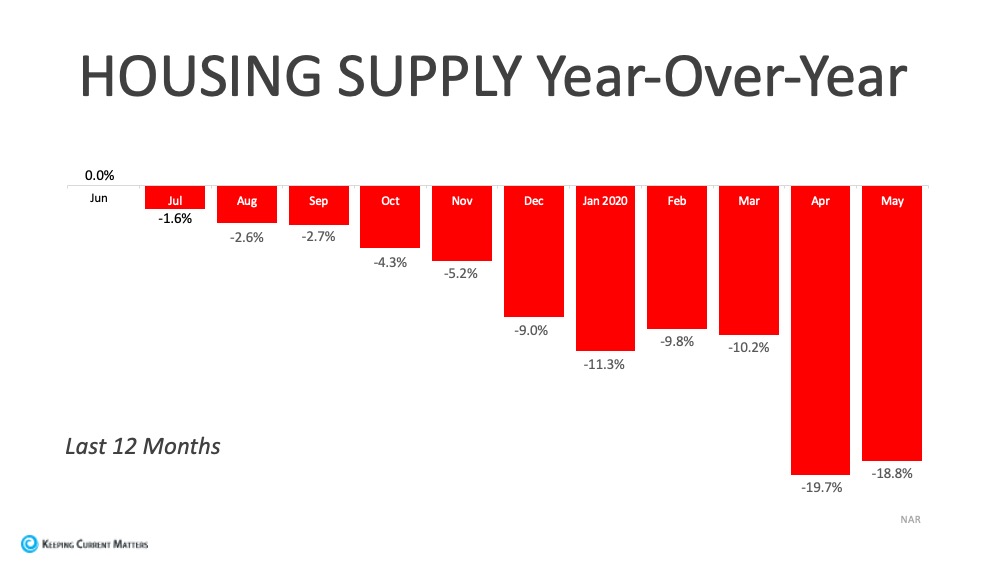
As we move through the year, we’ll see an increase in the number of houses being built. This will help combat a small portion of the inventory deficit. The lack of overall inventory, however, is still a challenge, and it is creating an opportunity for homeowners who are ready to sell. As the graph below shows, during the last 12 months, the supply of homes for sale has been decreasing year-over-year and is not keeping up with the demand from homebuyers.

A Historic Rebound for the Housing Market | Keeping Current Matters

Bottom Line

If you decided not to sell this spring due to the health crisis, maybe it’s time to jump back into the market while buyers are actively looking for homes. Reach out to a local real estate professional to determine your best move forward.


Tuesday, June 23, 2020

TreeTops Update

TreeTops will be releasing the last 7 Summit homesites this Saturday June 27th!  The Elmont/Empire, Fairview/Felicity, Garland/Gilliam, and the Hartford/Hopewell can be built on these Summit sites. The map below shows the NEW release sites in yellow and currently available Summit sites in blue. Please reach out to me for more information or to schedule a visit! These beautiful exterior sites will not last long!
I have a great working knowledge of TreeTops and am happy to answer any questions you have about the community. 

Remember that it is always in your best interest to have your own representation when buying from a builder. The sales staff works for the builder, not you. When visiting new construction for the first time, you should always have your agent with you or, if this is not possible, be sure to have your agent's card with you. As an Accredited Buyers Representative, I am committed to taking care of your best interests. Please call me before visiting new construction homes.

What Are the Experts Saying About Future Home Prices?

Article Courtesy of Keeping Current Matters/The KCM Blog


A worldwide pandemic and an economic recession have had a tremendous effect on the nation. The uncertainty brought about by both has made predicting consumer behavior nearly impossible. For that reason, forecasting home prices has become extremely difficult.

Normally, there’s a simple formula to determine the future price of any item: calculate the supply of that item in ratio to the demand for that item. In housing right now, demand far exceeds supply. Mortgage applications to buy a home just rose to the highest level in 11 years while inventory of homes for sale is at (or near) an all-time low. That would usually indicate strong appreciation for home values as we move throughout the year.
Some experts, however, are not convinced the current rush of purchasers is sustainable. Ralph McLaughlin, Chief Economist at Haus, explained in their June 2020 Hausing Market Forecast why there is concern:
“The upswing that we’ll see this summer is a result of pent-up demand from homebuyers and supply-in-progress from homebuilders that has simply been pushed off a few months. However, after this pent-up demand goes away, the true economic scarring due to the pandemic will begin to affect the housing market as the tide of pent-up demand goes out.”
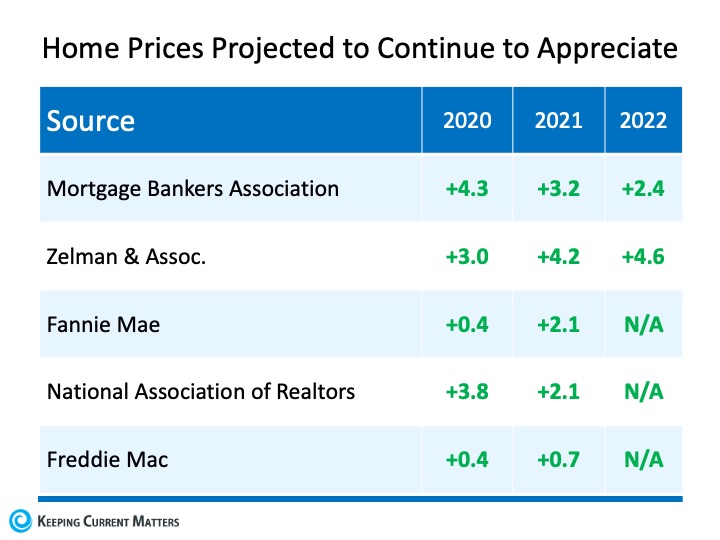
The virus and other challenges currently impacting the industry have created a wide range of thoughts regarding the future of home prices. Here’s a list of analysts and their projections, from the lowest depreciation to the highest appreciation:
We can garner two important points from this list:
  1. There is no real consensus among the experts.
  2. No one projects prices to crash like they did in 2008.

Bottom Line

Whether you’re thinking of buying a home or selling your house, know that home prices will not change dramatically this year, even with all of the uncertainty we’ve faced in 2020.

Wednesday, June 3, 2020

Is it Time to Sell Your Vacation Home?

Article Courtesy of Keeping Current Matters/The KCM Blog


The travel industry is one of the major sectors that’s been hit extremely hard by the COVID-19 pandemic. Today, it’s hard to know how long it will take for summer travelers to be back in action and for the industry to fully recover. Homeowners who rent their secondary properties on their own or through programs like Airbnb, which has over 660,000 listings in the U.S. alone, have been impacted in this challenging time. Some of these homeowners are considering selling their vacation homes, and understandably so.
A recent CNN article indicated:
“With global travel screeching to a halt during the pandemic, a number of Airbnb hosts are planning to sell their properties…These desperate moves come as hosts face the possibility of losing thousands of dollars a month in canceled bookings while bills, maintenance costs, and mortgage payments pile up.”
If you’re one of the property owners in this position, you too may be feeling the pain of decreased travel, especially as we prepare for the typical busy summer vacation season. A recent survey notes that 48% of Americans have already canceled summer travel plans due to the current health crisis. In addition, 36% indicated they don’t have vacation plans, and only 16% said they did not cancel their summer travel.

The same survey also asked, “How long will you wait before traveling again?” Not surprisingly, only 29% of respondents are planning to travel within the next 6 months. That means 71% are putting their plans on hold for at least 6 months, or are still unsure about future travel. That can continue to add to the significant income loss that many property renters felt this spring.


If you’re considering selling your rental property, know that there are two key factors indicating that selling your vacation home now may be your best move as a homeowner.

1. Inventory Shortage

The inventory of overall homes for sale is well below the demand from potential buyers, so many eyes may be searching for a home like yours. According to the National Association of Realtors (NAR), total housing inventory, meaning homes available to purchase, is down 19.7% from one year ago (see graph below):


Inventory across the country continues to be a challenge, with only a 4.1-month supply of listings available at the current sales pace. For a balanced market, where there are enough homes available for interested buyers to purchase, that number would need to bump up to a 6-month supply. This means we don’t have enough inventory for the number of buyers looking for homes, so selling in this scenario is ideal. Buyers are looking now, and some vacation homes make a great primary residence or second home for those eager to escape from more populated urban areas.

2. Home Prices

The lack of inventory is also keeping homes from depreciating in value. Today, prices are holding strong and experts forecast home price appreciation to continue throughout this year. Selling your home while prices are holding steady is a sound business move. You’ll likely have equity you’ve earned working for you as well. If your home has been vacant for the past few months, the forced savings you have built in your equity may help balance out possible rental income loss due to the slowdown in the travel industry.

Bottom Line

We don’t know exactly when heightened summer travel will return or what it will look like when it does. If you’re considering selling your vacation home, contact a local real estate professional to determine your options in the current market.

Tuesday, June 2, 2020

Home Prices: It’s All About Supply and Demand

Article Courtesy of Keeping Current Matters/The KCM Blog

Home Prices: It’s All About Supply and DemandAs we enter the summer months and work
 through the challenges associated with the current health crisis, many are wondering what impact the economic slowdown will have on home prices. Looking at the big picture, supply and demand will give us the clearest idea of what’s to come.

Making our way through the month of June and entering the second half of the year, we face an undersupply of homes on the market. Keep in mind, this undersupply is going to vary by location and by price point. According to the National Association of Realtors (NAR), across the country, we currently have a 4.1 months supply of homes on the market. Historically, 6 months of supply is considered a balanced market. Anything over 6 months is a buyer’s market, meaning prices will depreciate. Anything below 6 months is a seller’s market, where prices appreciate. The graph below shows inventory across the country since 2010 in months supply of homes for sale.

Robert Dietz, Chief Economist for the National Home Builders Association (NAHB) says:
“As the economy begins a recovery later in 2020, we expect housing to play a leading role. Housing enters this recession underbuilt, not overbuilt. Estimates vary, but based on demographics and current vacancy rates, the U.S. may have a housing deficit of up to one million units.”
Given the undersupply of homes on the market today, there is upward pressure on prices. Looking at simple economics, when there is less of an item for sale and the demand is high, consumers are willing to pay more for that item. The undersupply is also prompting bidding wars, which can drive price points higher in the home sale process. According to a recent MarketWatch article:

 “As buyers return to the market as the country rebounds from the pandemic, a limited inventory of homes for sale could fuel bidding wars and push prices higher.”
In addition, experts forecasting home prices have updated their projections given the impact of the pandemic. The major institutions expect home prices to appreciate through 2022. The chart below, updated as of earlier this week, notes these forecasts. As the year progresses, we may see these projections revised in a continued upward trend, given the lack of homes on the market. This could drive home prices even higher. 

 Bottom Line
Many may think home prices will depreciate due to the economic slowdown from the coronavirus, but experts disagree. As we approach the second half of this year, we may actually see home prices rise even higher given the lack of homes for sale.