Please check out the tabs above.
They provide a wealth of information!
Use Blog Archive on bottom of left sidebar for a list of all blog postings.
Article Courtesy of Keeping Current Matters/The KCM Blog

“The week of September 27–October 3 brings together the market conditions buyers value most—elevated inventory, less competition and prices that have eased from their seasonal high—giving prepared buyers a way to offset high rates with savings on price and room to negotiate with confidence.”
But that’s the national best week. Depending on where you live, your local sweet spot may come a little earlier or later (see map below):

It all depends on local trends and how inventory and buyer demand ebbs and flows seasonally where you want to live. But no matter when your market hits its peak, here are some of the perks you can expect this time of year.
For starters, there are more homes to choose from. In fact, data from the National Association of Realtors (NAR) shows the number of homes for sale recently reached its highest level in more than 10 years:
“NAR’s data does show a strong uptick in for-sale inventory at the end of the summer, reaching the highest level in more than 10 years.”
That means you may have a better shot at finding something you love and can afford without making as many compromises. And that’s not the only advantage.
Realtor.com says buyers during this window could see home prices about $14,000 lower than the summer peak, along with 30% less competition from other buyers. Plus, homes tend to stay on the market almost 2 weeks longer (13 days), giving you a little more breathing room to make a decision.
More choices.
Better pricing.
Less competition.
That combination could be enough to ease some of the pressure higher mortgage rates are putting on your budget.
But you certainly don’t have to buy during that very specific window. This isn’t a one-week-only opportunity. History tells us conditions should be tipped in your favor for the entire month of October:

In fact, Realtor.com says 42 of the 50 largest metros see their best week to buy fall sometime during October. So, don’t feel like you have to rush to hit one specific date. Use the time now to get things lined up, then jump in when the timing is right for you. As Guaranteed Rate explains:
“The best time to buy a home depends on your needs. Certain seasons can give you an advantage when starting your homebuying journey.”
If you want to buy a house this year, there’s still a way to make it happen, even with today’s rates. This fall gives you the chance to get some of the best seasonal perks the market has to offer.
Want help figuring out when those advantages typically show up in your market?
Have a quick conversation with a lender and a local agent about how your market works and the steps you’ll need to take to get ready.


We need to realize we’re not just transferring wealth, says Lark (Dr. Regina Lark, certified professional organizer) “We’re transferring volume.” These are physical assets that occupy real space. And with them comes significant emotional weight, but not necessarily any monetary value. That’s the sticky wicket.
For many older Americans, items like Hummel figurines, baseball cards, records, or wedding dishes represent identity and personal history. For heirs, receiving these objects might feel like an obligation. (Mom loved it, so I need to love it, too.) But just because these things were important to one generation doesn’t mean the next generation will assign them any value.
It’s not a matter of disrespect. It’s about generational values. Many household items are mass-produced and can be purchased and delivered to your home within a day or two. The way we entertain has evolved: Large gatherings aren’t about lace tablecloths and cut crystal. Technology has rendered so many things obsolete. Younger adults today might be living in smaller homes and moving more often. They prioritize flexibility and personal meaning over the accumulation of material goods. A lot has changed.
Article Courtesy of Keeping Current Matters/The KCM Blog

But that may be about to change. Here’s why your pool of options may actually start ticking back up again.
Active listings were up 2.1% year-over-year in July, according to Realtor.com. Back in January, inventory was up 10%. And in May of 2025, it was up 31.5%. So, growth has cooled off a lot over the last year.
The past 3 months, though, have all seen inventory growth land in roughly the same range, which is a sign this slowdown may be nearing its floor (see graph below):

So, what does that mean for you?
Homes are still coming onto the market. Every single one of these bars shows a period where inventory grew. So, don’t be discouraged or let this make you think you’re out of options. Plus, we’ve seen more stability in the numbers lately, which is a good sign.
Compared to the rock-bottom lows of 2021, inventory has climbed back substantially. Nationally, the number of homes for sale has been up year-over-year consistently now for 33 months. And inventory has almost doubled in just a few years. So don’t get too hung up on the pace of that increase.
This July was actually the best July for inventory since 2019 (see graph below):

Now, the market still needs about 150k listings to get back to pre-pandemic levels, but things are quickly approaching normal. And experts think we may even be back to 2019 levels by the end of this year, even with the slowdown we’ve already seen.
And that’s thanks to one unlikely factor: mortgage rates.
It works like this. When mortgage rates climb, inventory tends to climb with them. As Mike Simonsen, Chief Economist at Compass, explains:
“When rates rise; inventory rises. When rates fall; inventory falls. So, from July last year to March this year, rates ease lower and all the inventory growth of the past several years evaporated. If rates move higher from here or stay elevated for [a] longer period of time, then we should expect supply to build again.”
Well, rates are expected to hold in the mid-to-upper 6% range for a while longer, and Realtor.com‘s latest forecast has inventory ending 2026 up 3.6% year-over-year.
That means 2 things:
Inventory growth is forecast to pick up a little bit throughout the rest of the year.
And, inventory is projected to close the year at a historically normal level, right about where it stood at the end of 2019.
For buyers, that’s a win. Even if today’s rates aren’t your favorite, they’re helping the number of homes on the market to grow. And more homes for sale means more choices, more room to negotiate, and less pressure to rush your search.
The number of homes for sale is growing slowly but surely, and that means more options for your move. Want to see what’s available in your area? Reach out to a local real estate agent.
Article Courtesy of Keeping Current Matters/The KCM Blog
That spare room on the main floor. The finished basement with a kitchenette and its own entrance. The bonus room you’ve been using for storage.
To you, it’s extra space. But to a growing pool of buyers, it’s the reason they’d pick your house. Here’s why. Multi-generational homebuying is on the rise.
The number of multi-generational households is climbing. That’s when 3 or more generations live under one roof. And data shows those households grew from 3.2 million to almost 4 million between 2014 and 2024, according to Realtor.com.
And each year, more people are shopping for a larger home that fits their combined needs.
While the appetite for this type of house is rising across the board, data from USAFacts shows multi-generational living is more common in some states than others. The darker the state in the map below, the more common it is in that area (see map below):
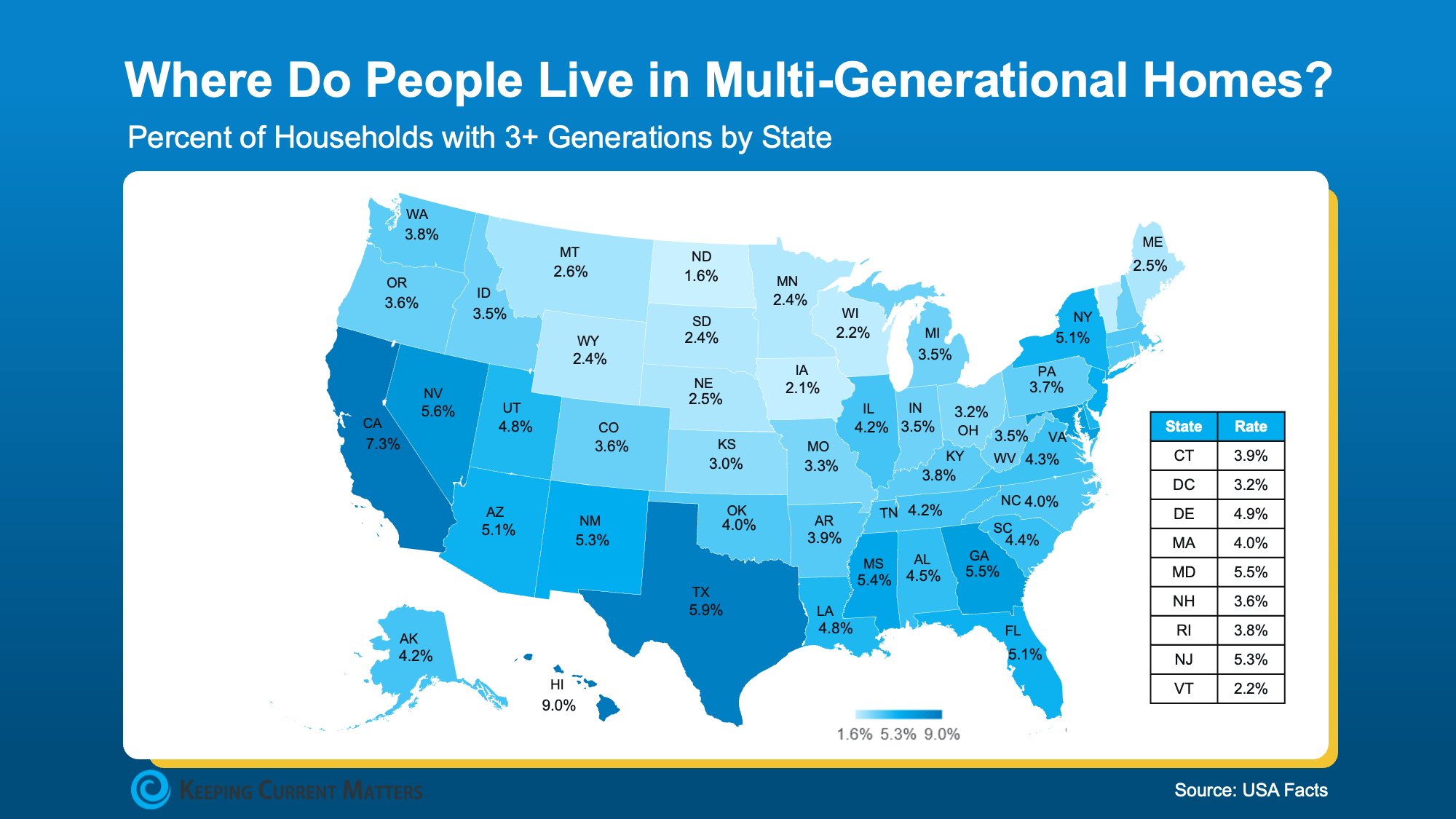
Where does your state fall? Depending on where you are, the pool of buyers looking for a house like yours could be even bigger than you’d think. But the overall bottom line is this.
There’s a real market out there for larger homes with room for multiple generations under one roof, especially since affordability is still so tight. And if you own a house like that, it’s in demand.
And that extra room carries real value with the right buyer. According to Realtor.com, in 2025 the median asking price for a multi-generational house was $709,000 – roughly 65% higher than the $429,900 median for a standard house.
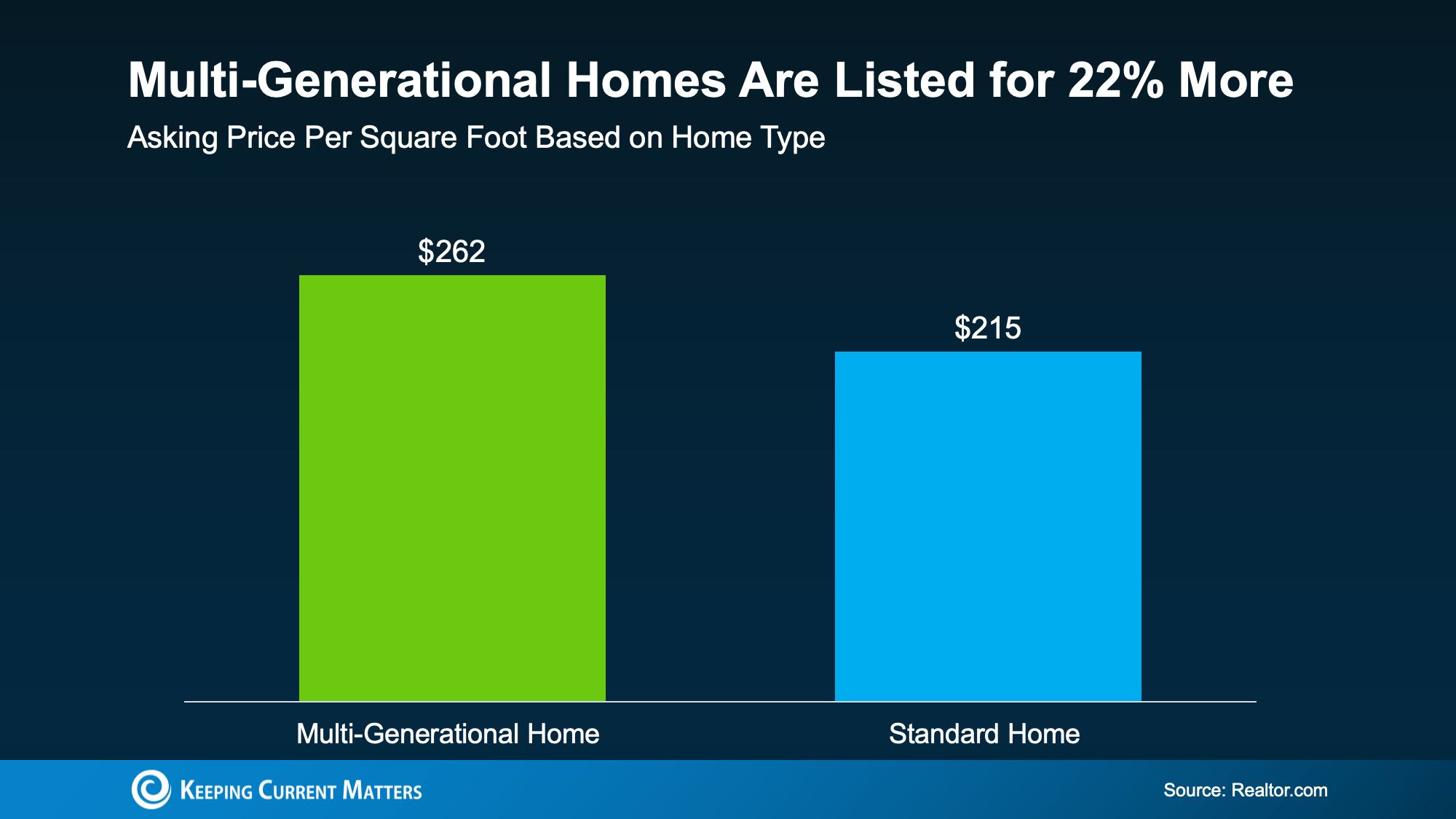
Some of that is simply size. But compare multi-generational homes to regular homes with the same amount of square footage, and they still come out on top – $262 per square foot versus $215.
That’s a 22% premium you could command for special features like in-law suites, second kitchens, and separate entries (see graph below):
When you sell, this could help you walk away with more money in your pocket, especially when your agent highlights your home’s multi-generational-friendly features in your listing.
And even with slightly higher price tags, buyers aren’t flinching. Multi-generational houses drew 13.5% more online views than standard ones, and they still sold just as fast – in about 59 days – per the same Realtor.com report.
Hannah Jones, Senior Economic Research Analyst at Realtor.com, explains:
“The strong demand and steep premiums we are seeing in inventory-constrained markets point to a real mismatch between what buyers are looking for and what is actually available. For sellers in these markets, this type of home can be a significant asset.”
Basically, when buyers want something that’s very specific, the house that checks the box tends to stand out.
Your multi-generational-friendly, or simply larger-than-average, house might meet criteria a lot of buyers can't find in a standard one. That's what gets attention. And offers. So, talk to a local real estate agent about what it could get you in your market right now.
Article Courtesy of Keeping Current Matters/The KCM Blog

The interesting thing is… both can be right at the exact same time. It just depends on where you live.
That’s because today’s housing market isn’t moving in one direction anymore. Some markets clearly favor buyers. Others still favor sellers. But most are sitting somewhere in the middle.
And knowing which market you’re actually in can completely change the strategy you use to buy or sell (and what expectations you should have). Let’s break it down.
So how do you know which market you’re in? There’s one number that tells the story faster than anything else: the months’ supply of homes for sale. It’s the clearest signal of who’s got leverage – and what strategy you’ll need. Think of it like this.
Imagine no additional homes were listed starting today. Months’ supply tells us how long it would take to sell everything that’s currently on the market based on today’s demand.
Generally speaking, if months’ supply is:
Fewer than 4 months: Sellers usually have the advantage.
4 to 6 months: Buyers and sellers are on more equal footing.
More than 6 months: Buyers can usually negotiate for a better deal.
Right now, the National Association of Realtors (NAR) data says that number is 4.6 and that puts the overall market back in balanced territory (see graph below):

That means, as a whole, the market has finally moved back into a much more balanced range after years of being tilted in sellers’ favor. While that may look like the scales have tipped only slightly, it’s enough to make a real difference in what strategy you’ll need for your move – at least in most places.
Redfin data helps shed some light on how this shakes out across the country. It breaks down which cities are leaning in either direction (see graph below).
Some markets give buyers more leverage. Those are in blue.
Some still favor sellers. That’s the orange.
Others fall somewhere in between. Those are gray.

Notice anything? A lot more places are seeing more buyer-friendly conditions right now. In fact, this is the most buyer-friendly market we’ve seen in nearly 6 years.
But don’t take that as buyers have the upper hand everywhere.
There are still cities where sellers still have the power. And if you’re in one of them, your approach to selling or buying looks completely different than it would in a buyer-leaning market.
That’s why the biggest mistake isn’t thinking it’s finally a buyer’s market. And it isn’t thinking it’s still a seller’s market either. It’s making any assumption without talking to an expert agent first.
Today’s market is incredibly local. In one market, a buyer may be getting thousands of dollars in concessions from a seller. And a homeowner may have to consider dropping their price.
But in another, a buyer may be stressed about coming in with their best offer, or they may lose out on the home to another buyer. And a seller may still be seeing strong demand and prices inching higher.
Same overall housing market.
Very different experiences.
The truth is what’s happening in your back yard affects everything from pricing your house to making an offer to negotiating repairs or concessions. And that’s why an agent’s local knowledge matters more now than ever before.
Your plan has to be based on your neighborhood – and only an agent has the expertise to get that right.
This market isn’t one-size-fits-all.
If you're wondering who has the upper hand where you live, talk to a local agent. They’ll help you understand what's happening in your market, who's got the leverage, and what strategy gives you the best shot at getting what you want.


Article Courtesy of National Association of REALTORS® (NAR)

Almost three-quarters (72%) of recent homebuyers say they have either seen or suspected cameras, microphones, or recording devices during a home tour, according to a recent survey by LendingTree.
And, at least 56% of sellers surveyed admitted they had recording devices active during a walkthrough.
Click HERE to read the entire article.