Wednesday, May 7, 2025

Why Some Homes Sell Faster Than Others

Article Courtesy of Keeping Current Matters/The KCM Blog
 
As you think ahead to your own move, you may have noticed some houses sell within days, while others linger. But why is that? As Redfin says:

“. . . today’s housing market has been topsy-turvy since the pandemic. Low inventory (though rising) and high prices have created a strange mix: Some homes are flying off the market, while others sit for weeks.”

That may leave you wondering what you should expect when you sell. Let’s break it down and give you some actionable tips on how to make sure your house is one that sells quickly.

Homes Are Still Selling Faster Than Pre-Pandemic

The first thing you should know is that, in most markets, things have slowed down a little bit. While you may remember how quickly homes sold a few years ago, that’s not what you should expect today.

Now that inventory has grown, according to Realtor.com, homes are taking a bit longer to sell in today’s market (see graph below):


But before you get hung up on the ten-day difference compared to the past few years, Realtor.com will help put this into perspective:

“In April, the typical home spent 50 days on the market . . . This marks the 13th straight month of homes taking longer to sell on a year-over-year basis. Still, homes are moving more quickly than they did before the pandemic . . .

By this comparison, if your house does take a little more time to sell this year, it’s not really a concern. It’s actually still faster than the norm. Plus, it gives you a bit more time to find your next home, which is welcome relief when you’re trying to move, too.

Just remember, some homes sell in less time than this. Some take even longer. So, what’s the real difference? Why do some homes attract eager buyers almost instantly, while others sit and struggle?

It comes down to having the right agent and strategy. Here are a few tips you need to know. 

1. Price It Right

One of the biggest reasons homes sit on the market is overpricing. Many sellers want to shoot for a higher price, thinking they can lower it later – but that backfires by turning buyers away.

What to do: Work with an agent to make sure your house is priced right. They’ll analyze recent comparable sales (what other homes have sold for recently in your area), so you know you’re pricing appropriately for today’s market and what buyers are willing to pay. As Chen Zhao, Economic Research Lead at Redfin, explains:

“My advice to sellers is to price your home fairly for the shifting market; you may need to price lower than your initial instinct to sell quickly and avoid giving concessions.”

2. Focus on the First Impression

A messy yard or a house that needs paint? It’ll turn buyers off. Since buyers decide within seconds whether they like a home, a good first impression is key.

What to do: Outside, clean up your front yard, tidy up your landscaping, power wash walkways, and add fresh mulch. Inside, declutter and depersonalize. And consider minor touch-ups like repainting in a neutral tone. Your agent will offer advice on what to tackle.

3. Strong Marketing & High-Quality Listing Photos

If your listing or your photos don’t look professional, you could have trouble drawing in buyers who think you’re trying to cut corners.

What to do: Instead, lean on your agent’s skills, expertise, and resources. They’ll help you make sure you have:

  • High-resolution listing photos showing the home in its best light.
  • Detailed descriptions that highlight differentiating features of your house.
  • Your listing on multiple platforms, including major real estate sites and social media.

4. The Location of the Home

You may have heard the phrase “location, location, location” when it comes to real estate. And there’s definitely some truth to that. Homes in highly sought-after neighborhoods tend to sell faster.

What to do: While you can’t change where your house is located, your agent can highlight the best features of your neighborhood or community in your listing. By showcasing what’s great about your area, they can help draw buyers into what life would look like in your house.

Bottom Line

Homes that sell quickly don’t necessarily have better features – they have better agents and a better strategy.

Are you thinking about selling? Connect with an agent to talk about how to get your home sold quickly and for top dollar.


Wednesday, April 30, 2025

BEAUTIFUL CUMBERLAND HALL WITH BASEMENT


This stunning home is both a peaceful retreat and an entertainer’s paradise! Sitting on a premium wooded lot, it's a serene sanctuary for the most discriminating buyer.The main level features a gourmet kitchen with a 5-burner gas stove, new refrigerator(2024) & microwave(2025), & a breakfast nook with a bright bay window, in addition to a formal dining area and beautiful study/office. Fabulous views of the woods from the sunroom, great room, primary bedroom, and screened porch. The lower level boasts a very spacious entertainment area composed of 3 large open rooms, including a large tiled sunroom that opens to a covered patio, as well as a wet bar, a specially lit game room with a full-size pool/air hockey table, a 4th bedroom, full bath, finished flex room, and a shelved storage room. Situated near the front of Sun City and close to the Lake House, this fabulous home offers easy access to all the beautiful amenities and diverse activities this premier 55+ community has to offer!

Wednesday, April 23, 2025

What’s Your House Worth Now? The Answer May Surprise You

Article Courtesy of Keeping Current Matters/The KCM Blog

Let’s talk about something you might not check nearly as often as your bank account – and that’s how much your home is worth. But when it comes to your financial situation, it’s an important thing to remember. When’s the last time you had a professional show you the value of your home?

Think about it. For most people, your house is probably the biggest asset you have. And if you’ve owned your home for a few years (or longer), chances are it’s been quietly building wealth for you in the background. And honestly? You might be surprised by just how much. 

What Is Home Equity?

This wealth you may not even realize you have comes in the form of home equity. Home equity is the difference between what your house is worth and what you still owe on your mortgage. It grows over time as home values rise and as you pay down your mortgage each month. Here’s an example to help you really understand how this works.

Let’s say your house is now worth $500,000, and you have $200,000 left to pay off on your loan. That means you have $300,000 in equity. And most homeowners are sitting on some pretty significant equity right now.

According to Cotality (formerly CoreLogic), the average homeowner with a mortgage has about $311,000 in equity.

Why You Probably Have More Than You Think

Here are the two main reasons homeowners like you have record amounts of equity right now:

1. Significant Home Price Growth. According to the Federal Housing Finance Agency (FHFA), home prices have jumped by more than 57% nationwide over the last five years (see map below):


And if you purchased your home a few years ago (or more), this means your house is likely worth much more now than when you first bought it, thanks to how much prices have climbed lately.

2. People Are Living in Their Homes Longer. Data from the National Association of Realtors (NAR), shows the average homeowner stays in their home for about 10 years now (see graph below):


That’s longer than it used to be. And over that decade? You’ve built equity just by making your mortgage payments and riding the wave of rising home values.

So, if you’re one of those people who’s been in their home for that long, here’s how much the behind-the-scenes price growth has helped you out. According to NAR:

“Over the past decade, the typical homeowner has accumulated $201,600 in wealth solely from price appreciation.”

What Could You Actually Do with That Equity?

Remember, your house might be your biggest financial asset – and, if you’re smart about how you leverage your equity, it could open up some exciting opportunities for your future.

  • Use it to help buy your next home. Your equity could help you cover the down payment on your next home. In some cases, it might even mean you can buy your next house in all cash.
  • Renovate your current house to better suit your life now. And, if you’re strategic about your projects, they could add even more value to your home if you do sell later on.
  • Start the business you’ve always dreamed of. Your equity could be exactly what you need for startup costs, equipment, or marketing. And that could help increase your earning potential, so you’re getting yet another financial boost.

Bottom Line

Chances are, your house is worth a lot more than you realize. Whether you’re thinking about selling, upgrading, or simply want to understand your options, your equity isn’t just a number. It’s a tool.

Sunday, April 13, 2025

BEAUTIFUL COPPER RIDGE WITH BASEMENT IN SCCL

 
Come and enjoy resort-like living in amenity-rich Sun City Carolina Lakes. This beautiful 3BR/3BA Copper Ridge basement home is move-in ready. Main floor features a large great room, kitchen w/gas range, SS appliances, dining area, bright & beautiful sunroom, flex room (office/study/craft room), primary ensuite bedroom w/custom shower, BR 2 & bathroom. The spacious basement has a large great room, BR 3 w/sitting area, bathroom, large flex room, and utility room w/workbench storage space. Garage features full house surge protector, custom shelving, and electric car charging station. Fenced area ideal for pet. Great view of woods from upper level deck and patio off of basement. Now is the time to live your dream! Come and enjoy all the beautiful amenities & diverse activities this premier 55+ community has to offer! Sun City Carolina Lakes has a public golf course and is in close proximity to shopping, restaurants, medical facilities, recreation areas, entertainment, and more!

Saturday, April 5, 2025

Things To Avoid After You Apply for a Mortgage

 Infographic Courtesy of Keeping Current Matters/The KCM Blog
 

Some Highlights

  • Once a lender has reviewed your finances as part of the homebuying process, you want to be as consistent as possible. Don’t make any big changes that could affect your mortgage application.
  • Here are a few tips. Don’t change bank accounts or apply for new credit. And this one may surprise you, don’t buy appliances or furniture for your next home yet either.
  • The best tip of all? Before you do anything financial in nature, talk to your lender first.

Tuesday, April 1, 2025

Here’s What a Recession Could Mean for the Housing Market

Article Courtesy of Keeping Current Matters/The KCM Blog

Recession talk is all over the news, and the odds of a recession are rising this year. And that leaves people wondering what would happen to the housing market if we do go into a recession.

Let’s take a look at some historical data to show what’s happened in housing for each recession going all the way back to the 1980s.


A Recession Doesn’t Mean Home Prices Will Fall

Many people think that if a recession hits, home prices will fall like they did in 2008. But that was an exception, not the rule. It was the only time we saw such a steep drop in prices. And it hasn’t happened since.

In fact, according to data from CoreLogic, in four of the last six recessions, home prices actually went up (see graph below):

So, if you’re thinking about buying or selling a home, don’t assume a recession will lead to a crash in home prices. The data simply doesn’t support that idea. Instead, home prices usually follow whatever trajectory they’re already on. And right now, nationally, home prices are still rising at a more normal pace.

Mortgage Rates Typically Decline During Recessions

While home prices tend to stay on their current path, mortgage rates usually drop during economic slowdowns. Again, looking at data from the last six recessions, mortgage rates fell each time (see graph below): 

So, a recession means mortgage rates could decline based on the data. While that would help with affordability, don’t expect the return of a 3% rate.

Bottom Line

The answer to the recession question is still unknown, but the odds have gone up. But that doesn’t mean you have to wonder about the impact on the housing market – historical data tells us what usually happens.

Friday, March 28, 2025

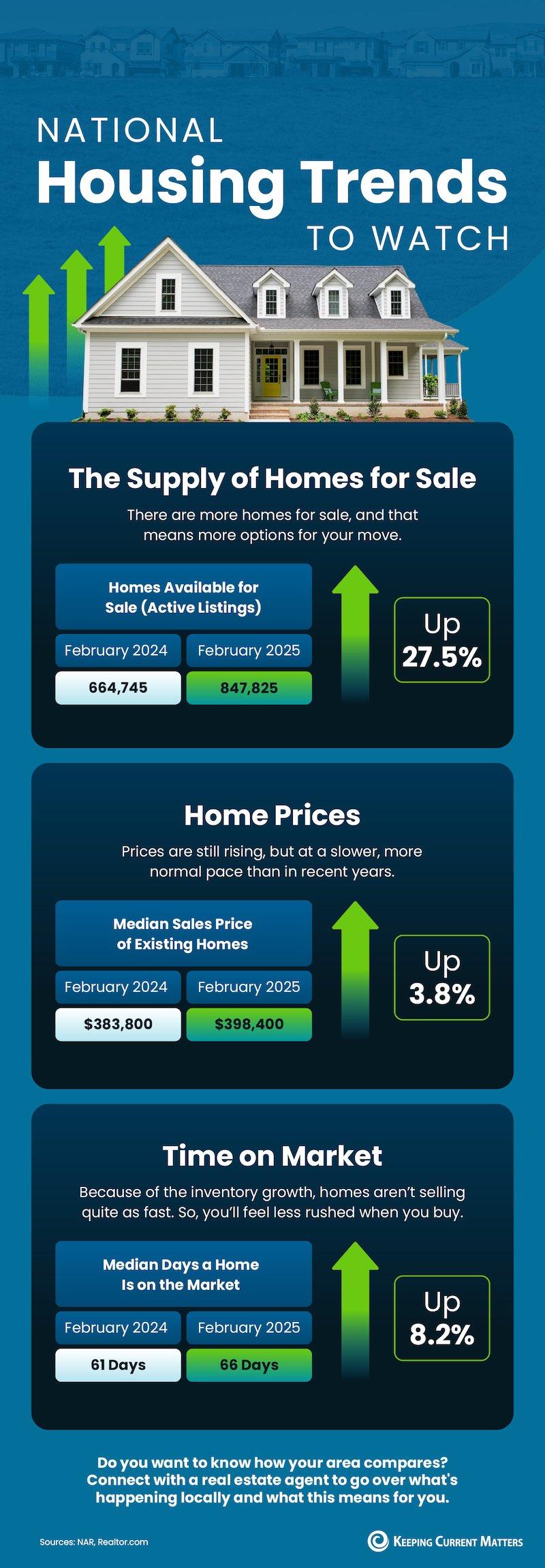
National Housing Trends To Watch

Infographic Courtesy of Keeping Current Matters/The KCM Blog

Some Highlights

  • At a national level, the housing market has shifted over the past year.
  • There are more homes for sale, price growth has moderated, and homes are taking a little longer to sell.
  • Do you want to know how your area compares? Connect with a real estate agent to go over what's happening locally and what this means for you.

Wednesday, March 19, 2025

What You Need To Know About Homeowner’s Insurance

Article Courtesy of Keeping Current Matters/The KCM Blog

Homeowner’s insurance is a must-have to protect what’s probably your biggest investment – your home. And while you never want to think about worst-case scenarios, the right coverage is basically your safety net if something goes wrong. Here’s how it helps you.

  • Covers Repairs and Rebuilding Costs: If your home is damaged by fire, storms, or other covered events, your policy helps pay for repairs or even a full rebuild.
  • Protects Your Belongings: Many policies can also cover personal items like furniture, electronics, and clothing if they’re stolen or damaged.
  • Provides Liability Coverage: If someone gets injured on your property, homeowner’s insurance can help cover medical bills or legal expenses.

In the simplest sense, it gives you peace of mind. Knowing you have protection against unexpected events helps you worry less. And with such a big purchase, having that reassurance is a big deal.

And while your first insurance payment will be wrapped into your closing costs, you’ll want this to be a part of your budget beyond closing day too. That’s because it’s a recurring expense you’ll have once you get the keys to your home.

Here’s what you need to know to help you budget for this important part of homeownership today.

Costs and Claims Are Rising

In recent years, insurance costs have been climbing. According to Insurance.com, there are four big reasons behind the jump in premiums:

  • More severe weather events and wildfires are leading to higher claims.
  • Insurance companies are pulling out of high-risk areas, reducing options for homeowners in some states.
  • Past rate increases haven’t kept up with the rise in claims.
  • The cost to rebuild or repair homes has gone up due to higher material and labor costs.

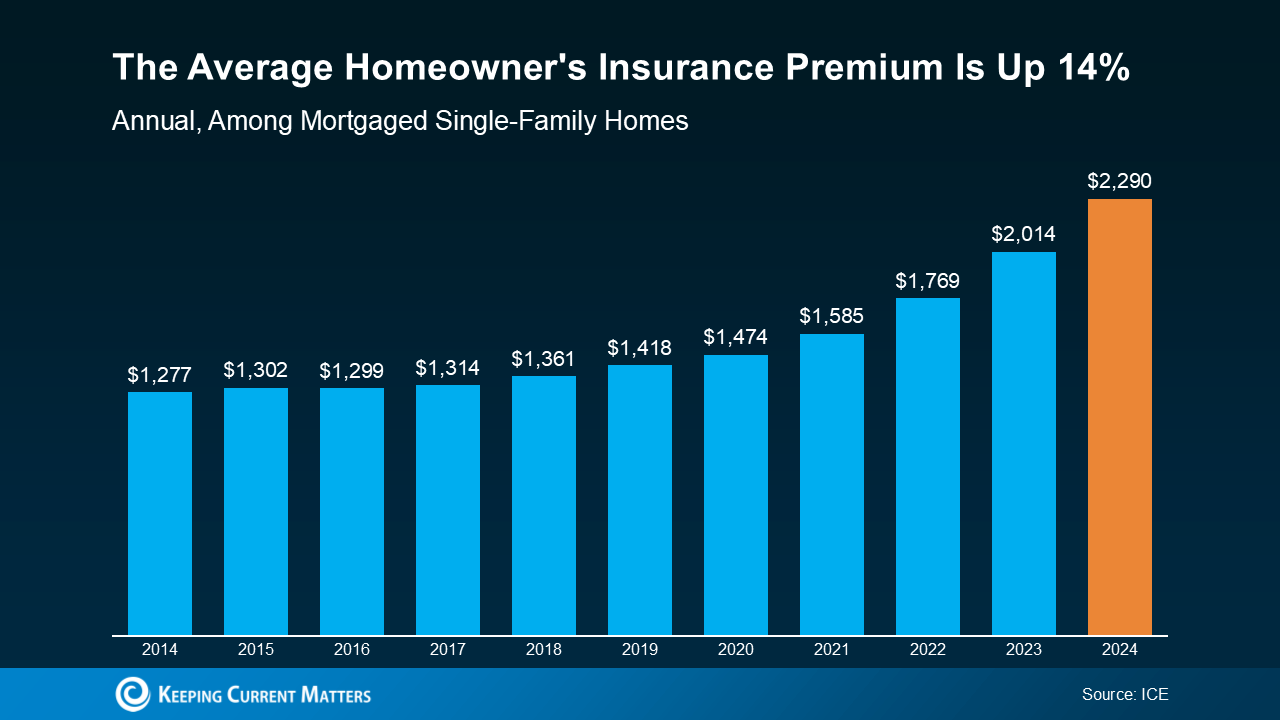
Basically, disasters are happening more often, repairs cost more, and insurers have to adjust their rates to keep up. Data from ICE Mortgage Technology helps paint the picture of how the average yearly premium has climbed over the last decade (see graph below):

What You Can Do About It

Homeowner’s insurance is a must to protect your home and your investment. But with costs rising, you’ll want to do your homework to balance the best coverage you can get at the best price possible.

Homeowner’s insurance rates vary widely based on location, provider, and coverage. Shop around and compare quotes before settling on a policy. And don’t forget to ask about discounts. Things like security systems or bundling with auto insurance could help lower your insurance costs.

Bottom Line

When you’re planning to buy a home, it’s important to look beyond just your mortgage payment. You’ll also want to budget for your homeowner’s insurance policy. It gives you a lot of protection against the unexpected. And while it’s true those costs are rising, there are things you can do to try to get the best price possible.

What’s your biggest concern when it comes to budgeting for homeownership? Talk to an agent to make sure you’re set up for success.

Tuesday, March 18, 2025

2025 Lancaster County Property Reassessment

 The Information Below is Courtesy of the Lancaster County Assessor's Office
 Link to original information: LANCASTER COUNTY ASSESSMENT  INFORMATION

Lancaster County, SC (March 7, 2025) – The Lancaster County Assessor’s Office will conduct the county’s 2026 general reassessment of real property, which will take effect in June 2025. The county follows a five-year reassessment cycle.

South Carolina Code of Laws, Section 12-43-217(A), mandates: “Notwithstanding any other provision of law, once every fifth year, each county or the state shall appraise and equalize those properties under its jurisdiction. Property valuation must be completed at the end of December of the fourth year, and the county or state shall notify every taxpayer of any change in value or classification if the change is $1,000 or more. In the fifth year, the county or state shall implement the program and assess all property on the newly appraised values.”
 
When reassessment team members begin visiting properties, they will carry photo IDs and drive Lancaster County vehicles. Appraisers will visit residents’ homes to assess real property and take exterior photos and measurements to determine fair market value. No reassessment staff will enter any home.
 
Field assessments are expected to be completed in June 2025, and notices of new property evaluations will be mailed to property owners the first week of July 2025. These notices will also include details on how to appeal to the proposed assessed values. Please note: This is not a tax bill.
 
“The Assessor’s Office’s role is to establish fair market value for real property in Lancaster County, ensuring the property tax burden is shared fairly and equally,” Lancaster County Assessor Brad Carnes said. “This year, the Assessor’s Office is conducting a countywide reassessment of real property within its jurisdiction in accordance with state law, which requires reassessment every five years.”
 
If you have any questions regarding this mandated law, please contact the Assessor’s office at 803-285-6964 or assessor@lancastercountysc.gov
 
 -------------------------
 
For additional information on property tax re-evaluations, read this article which I published in November 2024.

Wednesday, March 5, 2025

Why a Pre-Listing Inspection May Be Worth It in Today’s Market

 Article Courtesy of Keeping Current Matters/The KCM Blog

Selling a house comes with a lot of moving pieces, and the last thing you want is a deal falling apart over unexpected repairs uncovered during the buyer’s inspection. That’s why it pays to anticipate potential issues before buyers ever step through the door. And one way to do that is with a pre-listing inspection.

What Is a Pre-Listing Inspection? 

A pre-listing inspection is essentially a professional home inspection you schedule before putting your house on the market. Just like the inspections your buyer will do after making an offer, this process identifies any issues with the condition of your house that could have an impact on the sale – like structural problems, faulty or outdated HVAC systems, or other essential repairs.

While it’s a great option if you’re someone who really doesn’t like surprises, Bankrate explains this may not make sense for all sellers:

While it can be beneficial for a seller to do, a pre-listing inspection isn’t always necessary. For example, if your home is relatively new and you’ve been the only owner, you’re most likely already aware of any big issues that could impact a sale. But for an older home, a pre-listing inspection can be very insightful and help you get ahead of any potential problems.

The key is deciding whether the benefits outweigh the costs for your situation. Sometimes a few hundred dollars now can get you information that’ll save you a lot of time and hassle later on.

Why It May Be Worth Considering in Today’s Market

Right now, buyers are more cautious about how much money they’re spending. And they want to be sure the home they’re buying is worth the expense. In a market like this, a pre-listing inspection can be your secret weapon to make sure your house shows well. Here are just a few ways it can help:

  • Gives You Time To Make Repairs: When you know about issues ahead of time, it gives you the chance to fix them on your schedule, rather than rushing to make repairs when you’re under contract.
  • Avoid Surprises During Negotiations: When buyers discover issues during their own inspection, it can lead to last-minute negotiations, price reductions, or even a deal falling through. A pre-listing inspection gives you a chance to spot and address any problems ahead of time, so they don’t turn into last-minute headaches or negotiation roadblocks.
  • Sell Your House Faster: According to Rocket Mortgage, if your house is listed in the best shape possible, there won’t be as many reasons for buyers to ask for concessions. That means you should be able to cut down on negotiation timelines and ultimately sell faster.

How Your Agent Will Help

But before you think about reaching out to any inspectors to get something scheduled, be sure to talk to an agent. Your agent will be able to give you advice on whether a pre-inspection is worthwhile for your house and the local market. Because it may not be as important if sellers still have the majority of the negotiation power where you live.

If your agent does recommend moving forward and getting one done, here’s how they’ll support you throughout the process.

  • Offer Advice on How To Prioritize Repairs: If the inspection uncovers problems, your agent will sit down with you and offer perspective on what’s going to be a sticking point for buyers so you know what to prioritize.
  • Knowledge of How To Handle Any Disclosure Requirements: After talking to your agent, you may decide not all of the repairs are worth it right now. Just be ready to disclose what you’re not tackling. Some states require disclosures as a part of a listing – lean on your agent for more information.

Bottom Line

While they’re definitely not required, pre-listing inspections can be especially helpful in today’s market. By understanding your home’s condition ahead of time, you can take control of the process and make informed decisions about what to fix before you list and what to disclose.

If you choose to skip this step, you may be just as surprised as your buyer by what pops up in their inspection. And that could leave you scrambling. Would you rather fix issues now or risk trying to save the deal later?