Information Courtesy of Keeping Current Matters/The KCM Blog
Some Highlights:
- The cost of waiting to buy is defined as the additional funds
it would take to buy a home if prices & interest rates were to
increase over a period of time.
- Freddie Mac predicts interest rates to rise to 5.2% by the third quarter of 2019.
- CoreLogic predicts home prices to appreciate by 5.1% over the next 12 months.
- If you are ready and willing to buy your dream home, find out if you are able to!
The following article is especially important for first-time buyers. If you know someone who is hoping to purchase a home, but is concerned about PMI (Private Mortgage Insurance), please share this article.
Article Courtesy of Keeping Current Matters/The KCM Blog
Saving for a down payment is often the biggest hurdle for a
first-time homebuyer as median incomes, rents, and home prices all vary
depending on where you live.
There is a common misconception
among homebuyers that a 20% down payment is required, and it is this
limiting belief that often adds months, and sometimes even years, to the
home-buying process.
So, if you can purchase a home with less than a 20% down payment… why aren’t more people doing just that?
One Possible Answer: Private Mortgage Insurance (PMI)
Freddie Mac defines PMI as:
“An insurance policy that protects the lender if you are
unable to pay your mortgage. It’s a monthly fee, rolled into your
mortgage payment, that is required for all conforming, conventional
loans that have down payments less than 20%.
Once you’ve built equity of 20% in your home, you can cancel your PMI and remove that expense from your mortgage payment.”
As the borrower, you pay the monthly premiums for
the insurance policy, and the lender is the beneficiary. The monthly
cost of your PMI depends on the home’s value, the amount of your down
payment, and your credit score.
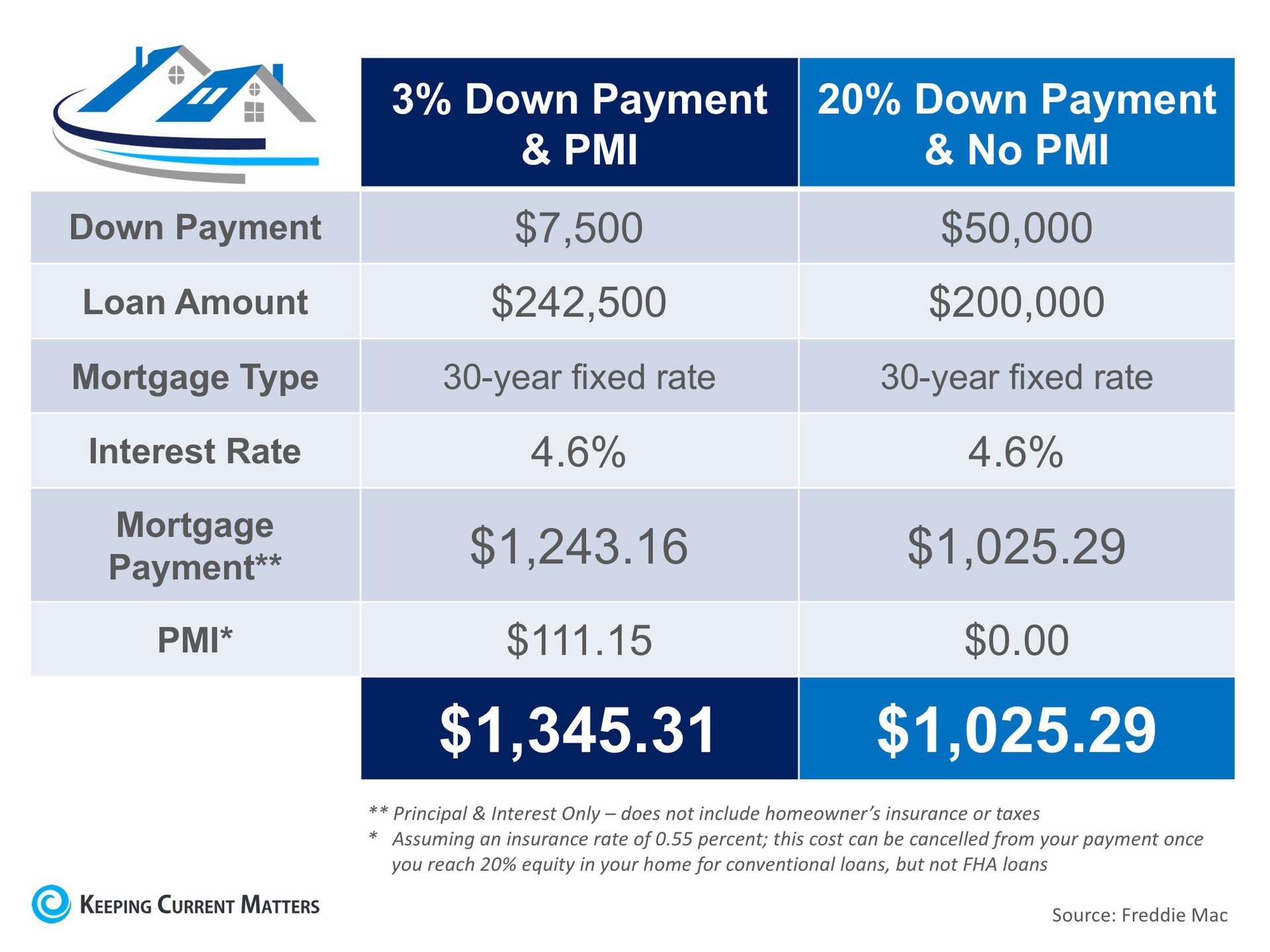
Below is a table showing the
difference in monthly mortgage payment for a $250,000 home with a 3%
down payment and PMI vs. a 20% down payment without PMI:
 The
first thing you see when looking at the table above is no doubt the
added $320 a month that you would be spending on your monthly mortgage
cost. The second thing that should stand out is that a 20% down payment is $50,000!
If
you are buying your first home, $50,000 is a large sum of money that
takes discipline and sacrifice to save. Many first-time buyers save for
5-10 years before buying their homes.
To save $50,000 in 10
years, you would need to save about $420 a month. On the other hand, if
you save that same $420 a month, you could afford a 3% down payment in
less than a year and a half.
In a recent article by My Mortgage Insider, they explain what could happen in the market while you are waiting to save for a higher down payment:
The
first thing you see when looking at the table above is no doubt the
added $320 a month that you would be spending on your monthly mortgage
cost. The second thing that should stand out is that a 20% down payment is $50,000!
If
you are buying your first home, $50,000 is a large sum of money that
takes discipline and sacrifice to save. Many first-time buyers save for
5-10 years before buying their homes.
To save $50,000 in 10
years, you would need to save about $420 a month. On the other hand, if
you save that same $420 a month, you could afford a 3% down payment in
less than a year and a half.
In a recent article by My Mortgage Insider, they explain what could happen in the market while you are waiting to save for a higher down payment:
“The time it takes to save a (larger) down payment could
mean higher home prices and tougher qualifying down the road. For many
buyers, it could prove much cheaper and quicker to opt for the 3% down
mortgage immediately.”
The article went on to say,
“Since renters typically devote a higher percentage of
their income to housing than homeowners, providing flexible down payment
options can help renters with solid earnings purchase a home – and gain
a fixed-rate mortgage with principal and interest payments that will
not increase over the life of the loan.”
If the prospect of having to pay PMI is holding you back from buying a home today, Freddie Mac has this advice,
“It’s no doubt an added cost, but it’s enabling you to buy
now and begin building equity versus waiting 5 to 10 years to build
enough savings for a 20% down payment.”
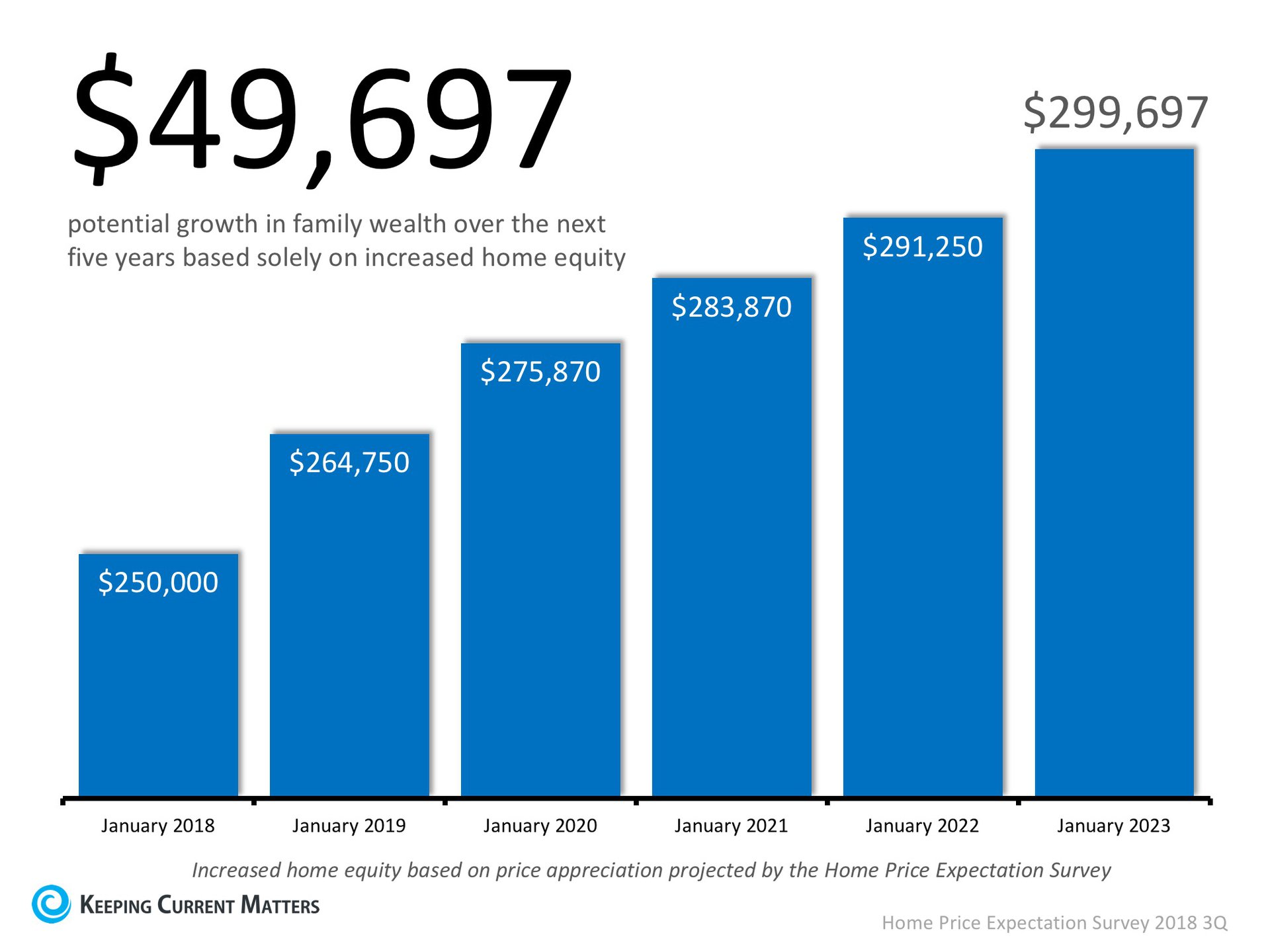
Based on results of the most recent Home Price Expectation Survey,
a homeowner who purchased a $250,000 home in January would gain $50,000
in equity over the next five years based on home price appreciation
alone (shown below).

Bottom Line
If
you have questions about whether you should buy now or wait until
you’ve saved a larger down payment, meet with a professional in your
area who can explain your market’s conditions and help you make the best
decision for you and your family.
4 Reasons Why We Are Not Heading Toward Another Housing Bubble
Article Courtesy of Keeping Current Matters/The KCM Blog
With home prices continuing to appreciate above historic levels, some
are concerned that we may be heading for another housing ‘boom &
bust.’ It is important to remember, however, that today’s market is
quite different than the bubble market of twelve years ago.
Here are four key metrics that will explain why:
-
- Home Prices
- Mortgage Standards
- Foreclosure Rates
- Housing Affordability
1. HOME PRICES
There is no
doubt that home prices have reached 2006 levels in many markets across
the country. However, after more than a decade, home prices should be
much higher based on inflation alone.
Last week, CoreLogic reported that,
“The inflation-adjusted U.S. median sale price in June
2006 was $247,110 (or $199,899 in 2006 dollars), compared with $213,400
in March 2018.” (This is the latest data available.)
2. MORTGAGE STANDARDS
Many
are concerned that lending institutions are again easing standards to a
level that helped create the last housing bubble. However, there is
proof that today’s standards are nowhere near as lenient as they were
leading up to the crash.
The Urban Institute’s Housing Finance Policy Center issues a monthly index which,
“…measures the percentage of home purchase loans that are
likely to default—that is, go unpaid for more than 90 days past their
due date. A lower HCAI indicates that lenders are unwilling to tolerate
defaults and are imposing tighter lending standards, making it harder to
get a loan. A higher HCAI indicates that lenders are willing to
tolerate defaults and are taking more risks, making it easier to get a
loan.”
Their July Housing Credit Availability Index revealed:
“Significant space remains to safely expand the credit
box. If the current default risk was doubled across all channels, risk
would still be well within the pre-crisis standard of 12.5 percent from
2001 to 2003 for the whole mortgage market.”
3. FORECLOSURE RATES
A
major cause of the housing crash last decade was the number of
foreclosures that hit the market. They not only increased the supply of
homes for sale but were also being sold at 20-50% discounts.
Foreclosures helped drive down all home values.
Today,
foreclosure numbers are lower than they were before the housing boom.
Here are the number of consumers with new foreclosures according to the
Federal Reserve’s most recent Household Debt and Credit Report:
- 2003: 203,320 (earliest reported numbers)
- 2009: 566,180 (at the valley of the crash)
- Today: 76,480
Foreclosures today are less than 40% of what they were in 2003.
4. HOUSING AFFORDABILITY
Contrary
to many headlines, home affordability is better now than it was prior
to the last housing boom. In the same article referenced in #1, CoreLogic revealed that in the vast majority of markets, “the
inflation-adjusted, principal-and-interest mortgage payments that
homebuyers have committed to this year remain much lower than their
pre-crisis peaks.”
They went on to explain:
“The main reason the typical mortgage payment remains well
below record levels in most of the country is that the average mortgage
rate back in June 2006, when the U.S. typical mortgage payment peaked,
was about 6.7 percent, compared with an average mortgage rate of about
4.4 percent in March 2018.”
The “price” of a home may be higher, but the “cost” is still below historic norms.
Bottom Line
After
using these four key housing metrics to compare today to last decade,
we can see that the current market is not anything like that bubble
market.
Infographic courtesy of Keeping Current Matters/The KCM Blog
Looking back in time gives us the opportunity to really appreciate the value of today's interest rates. While rates have started going up, today's rates remain significantly lower than in previous decades and buying power remains strong.
Some Highlights:
- With interest rates still around 4.5%, now is a great time to look back at where rates have been over the last 40 years.
- Rates are projected to climb to 5.1% by this time next year according to Freddie Mac.
- The impact your interest rate makes on your monthly mortgage cost is significant!
- Lock in a low rate now while you can!
VA Loans: Making a Home for the Brave Possible
Article Courtesy of Keeping Current Matters/The KCM Blog
 Since the creation of the Veterans Affairs (VA) Home Loans Program,
over 22 million veterans have achieved the American Dream of
homeownership. Many veterans do not know the details of the program and
therefore do not take advantage of the benefits available to them.
If
you are a veteran or you know someone who is, here is a breakdown of
the VA Home Loan benefits that can be used to achieve the American
Dream!
Since the creation of the Veterans Affairs (VA) Home Loans Program,
over 22 million veterans have achieved the American Dream of
homeownership. Many veterans do not know the details of the program and
therefore do not take advantage of the benefits available to them.
If
you are a veteran or you know someone who is, here is a breakdown of
the VA Home Loan benefits that can be used to achieve the American
Dream!
Top 5 Benefits of a VA Home Loan
- The greatest benefit of a VA Loan is that borrowers can buy a home with a 0% down payment. In 2016, 82% of all VA Loans put down 0%!
- Primary Mortgage Insurance (PMI) is not required! (Most other loans with down payments under 20% require PMI, which adds additional costs to your monthly housing expense!)
- Credit Score requirements are also lower for VA Home Loans. The average FICO® score of a borrower for an approved VA Loan is 620, compared to 676 (FHA) or 753 (Conventional).
- There is also a limitation on a veteran buyer’s closing costs. Sellers can pay all of a buyer’s loan-related closing costs and up to 4% in concessions in some cases.
- Even with interest rates rising, VA Loans continue to have the lowest average interest rates of all loan types.
Who Qualifies for a VA Home Loan?
One of the most important first steps when applying for a VA Home Loan is obtaining your Certificate of Eligibility (COE). “The COE verifies to the lender that you are eligible for a VA-backed loan.”
- Serve 90 consecutive days during wartime
- Serve 181 consecutive days during peacetime
- Have more than 6 years in the National Guard or Reserves
- Are the spouse of a service member who has died in the line of duty or as the result of a service-related disability
You Can Use a VA Loan To:
- Purchase a Home
- Purchase a Condo
- Build a Home
- Refinance an existing home loan
- Make improvements to a home by installing energy-related features or making energy-efficient improvements
Bottom Line
For more
information or to find out if you or a loved one would qualify to use
the VA Home Loan Benefit, contact a local real estate professional who
can help! Thank you for your service!